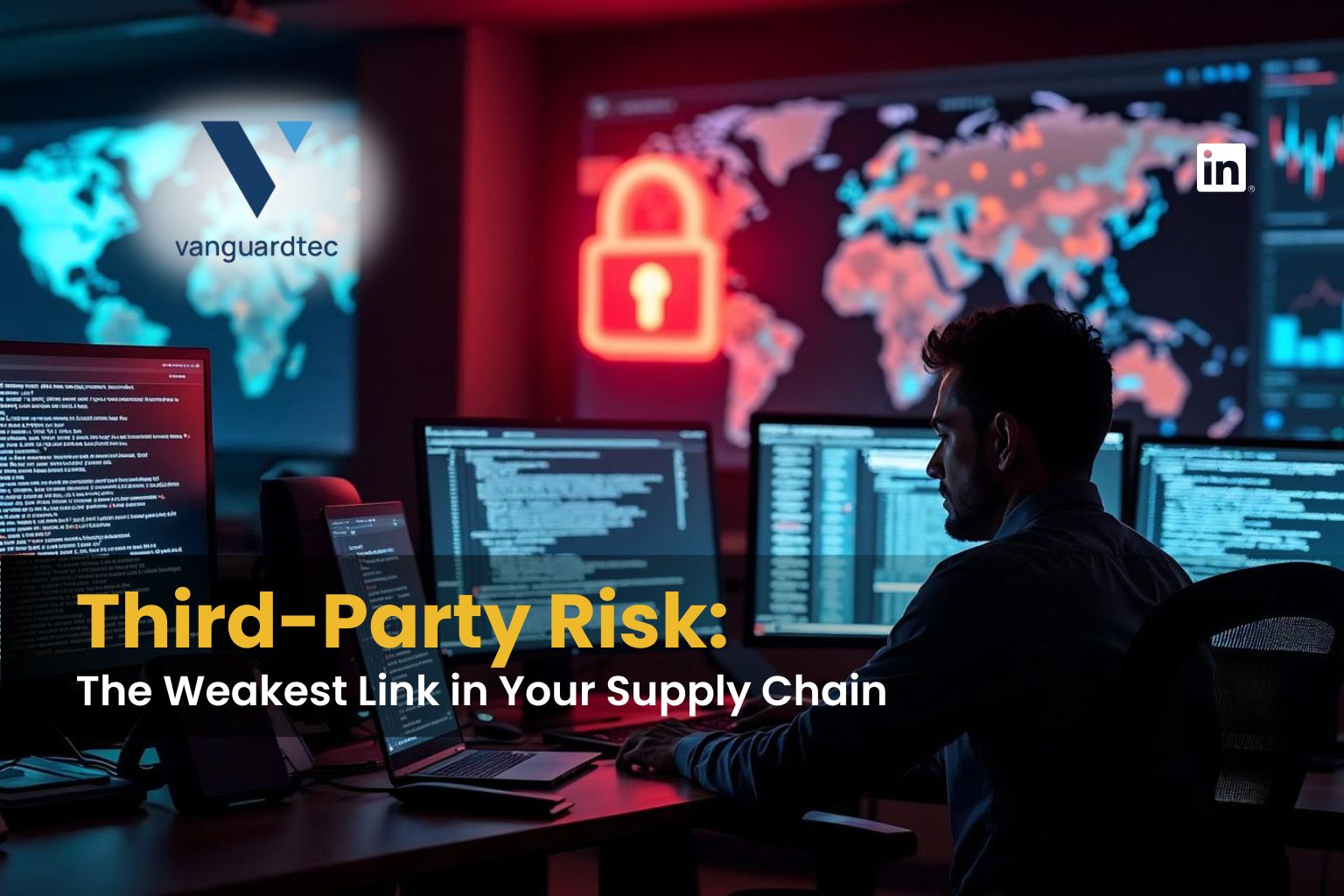
Third-Party Risk: The Weakest Link in Your Supply Chain

Third-Party Risk Management
0
min read
Apr 17, 2026
A delay in your supply chain doesn’t always start within your operations.
Sometimes… it begins with a third-party you trusted.
And by the time you realise it—
The impact has already started.
The Reality of Modern Supply Chains
Today’s supply chains are no longer linear.
They are interconnected ecosystems—built on vendors, suppliers, logistics partners, and technology providers.
While organisations continue to optimise internal processes, one critical risk often goes unnoticed:
Third-party dependency.
The Illusion of Control
On paper, everything looks under control:
Processes are defined.
Systems are optimised.
Teams are aligned.
But in reality, a large part of execution happens outside the organisation.
And that’s where control starts to fade.
Why Third-Party Risk Gets Ignored
In most organisations, vendor management is treated as a one-time task:
✔️ Vendor evaluated
✔️ Compliance completed
✔️ Contract signed
After that, focus shifts back to internal efficiency.
But supply chains don’t work in isolation.
They run on continuous collaboration—where even a small disruption at one point can impact the entire system.
The Real Impact of a Weak Link
When a third-party fails, the disruption doesn’t stay contained.
It spreads.
👉 Supply delays slow down production
👉 Inventory planning gets affected
👉 Delivery timelines slip
👉 Customer experience suffers
And the biggest challenge?
The response is often delayed due to lack of visibility.
The Visibility Gap
The real issue isn’t just risk.
It’s the inability to see it in time.
Most organisations lack:
Clear, real-time vendor performance insights
Early warning systems for disruptions
Defined escalation and response mechanisms
Which leads to a reactive approach—
action begins only after the damage is visible.
From Efficiency to Resilience
Traditionally, supply chains are built for:
✔️ Speed
✔️ Cost efficiency
✔️ Operational optimisation
But today, that’s not enough.
👉 Resilience is the new priority.
Resilient supply chains don’t just perform in stable conditions—
they adapt, respond, and recover when disruptions occur.
What High-Performing Organisations Do Differently
They don’t just depend on third parties—
they actively manage them.
🔹 Continuous Monitoring
Vendor performance is tracked regularly, not just during onboarding.
🔹 Operational Visibility
End-to-end visibility helps identify issues before they escalate.
🔹 Diversification
Reduced dependency on a single vendor lowers risk exposure.
🔹 Clear Ownership
Defined accountability ensures faster decisions during disruptions.
The Shift That Matters
Third-party risk is no longer just a procurement or compliance concern.
It’s a core operational priority.
Because in a connected supply chain:
Risks don’t stay external
Disruptions don’t stay isolated
Weak links don’t stay hidden
Final Thought
A supply chain rarely breaks all at once.
It weakens—gradually, silently, one link at a time.
And more often than not, that link is a third-party dependency.
The real question isn’t whether disruption will happen.
It’s this:
Will you see it coming—and act in time?
💬 Let’s discuss:
How is your organisation managing third-party risk in supply chain operations?
Latest Articles
Stay informed with the latest guides and news.